


There’s this theory that’s making the rounds. You’ve probably seen it.
Trump is running the most dangerous geopolitical blitz since Bretton Woods.
And the endgame isn’t a trade war.
There’s a theory circulating that Trump is running a far more ambitious play — one designed to collapse BRICS, force China’s hand, and lock in dollar dominance for… pic.twitter.com/Z5IrGSrfzZ
— GC Cooke (@Gccooke) March 5, 2026
“Trump is executing a 5D chess maneuver of historic proportions – cutting off China’s energy supply, flipping Russia, blowing up BRICS from the inside, and riding stablecoins to dollar supremacy for the next century”.
I admit, it’s intriguing, it’s bold, and it sounds elegant. It has this satisfying narrative arc with numbered steps and everything.
I, however, find it’s almost utterly bollocks.
I’m going to walk you through it. Piece by piece. Not because the underlying geopolitical moves aren’t real but because the interpretation being sold is the geopolitical equivalent of connecting random dots and calling it a masterpiece.
Let me show you why.
Step 1: Venezuela cuts China’s lifeline
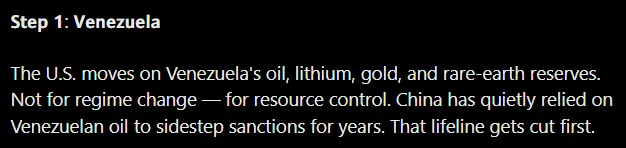
The theory opens with Venezuela as China’s critical energy artery – and severing it as the first domino. The US moves on Venezuelan oil. China’s “lifeline” gets cut. Step one complete.
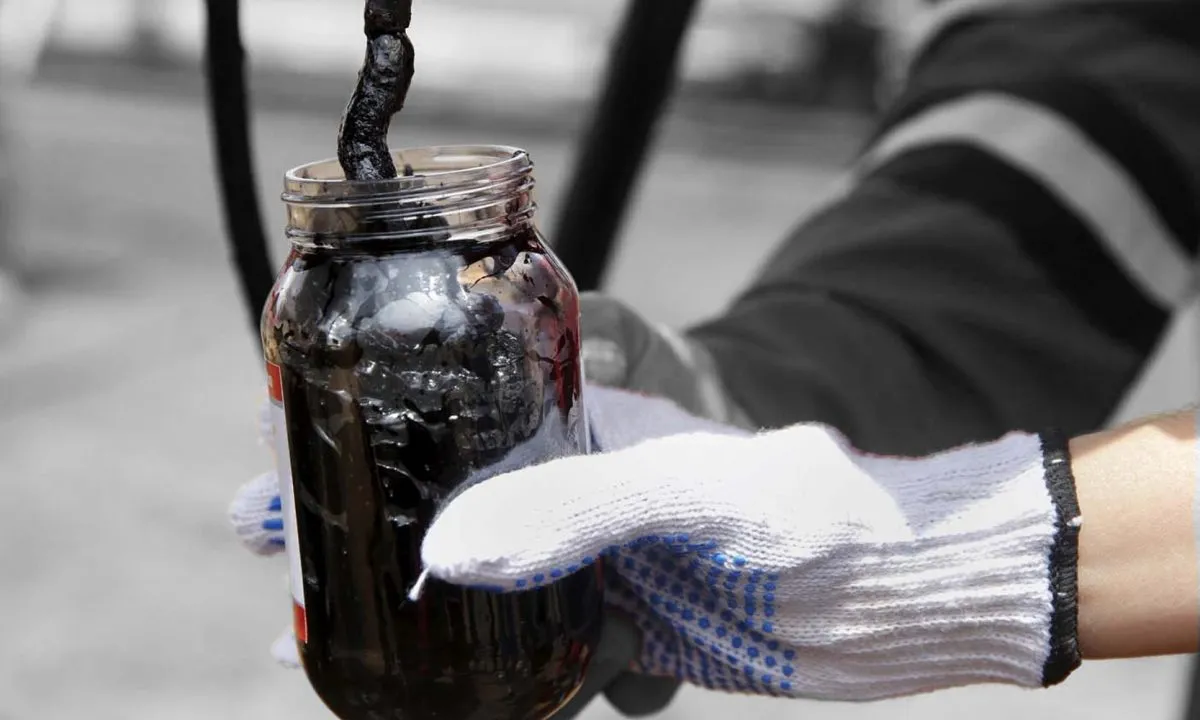
Well… Not really…
Of all China’s total seaborne crude imports, Venezuela accounted for maybe 4%. Four. That’s a trickle on a good day. Venezuelan crude went mostly to scrappy independent “teapot” refiners who process discounted sanctioned barrels. It’s not some severed jugular. It’s maybe a capillary.
There’s also a reason why those teapots are the buyers and not the big integrated refiners. The bulk of Venezuelan production is ‘Orinoco Belt’ crude. That’s extra-heavy sludge. We’re talking API gravity around 8-16°. For comparison, light sweet crude sits at 40°+. Venezuelan heavy requires specialised upgraders and cokers just to turn it into something a refinery can actually process. It also contains high sulfur on top of that, which means more hydrotreating, more capital, more complexity. It’s cheap precisely because it’s a pain to handle.
The presented theory suggests that Venezuelan oil is a strategic prize. It’s more like a discount bin item that nobody knows how to use.
And then there’s the “lithium, gold, and rare earths” angle. This is where the theory quietly switches from oil to minerals without acknowledging the problem: none of this comes online fast. Mine permitting, construction, and ramp-up run on decade-long timescales in the best conditions – not in a post-intervention country with crumbling infrastructure, unresolved property rights, and no functioning regulatory framework. And rare earths specifically: they’re not actually rare. They exist in many places. What’s rare is the processing capacity, and that’s environmentally horrific – acid leaching, radioactive byproduct management, tailings that contaminate watersheds for decades. China dominates rare earth processing not because they found the best deposits, but because they were willing to do the dirty work nobody else wanted to permit. Building that processing capacity elsewhere takes a decade and enormous political will. Venezuela is not where that happens.
And the moment Venezuelan flows to China started shrinking after Maduro’s capture in January, Chinese teapot refiners pivoted – instantly – to Iranian heavy crude. The same Iranian crude that traded at $10 discount to Brent. A cheaper alternative, available in greater volume, already flowing through well-established shadow fleet infrastructure. Step one’s intended effect lasted roughly three weeks before China’s supply chains shrugged and carried on.
Maduro was captured. Step one is technically complete. Trump boasted at the State of the Union about receiving 80 million barrels from “our new friend Venezuela” – which is roughly three days of global supply.
The theory assumes that cutting one sanctioned oil source forces China into a crisis. What actually happened is that China routed around it, because they’ve spent a decade building exactly the infrastructure to do that.
Step 2: Canada as loyal vassal
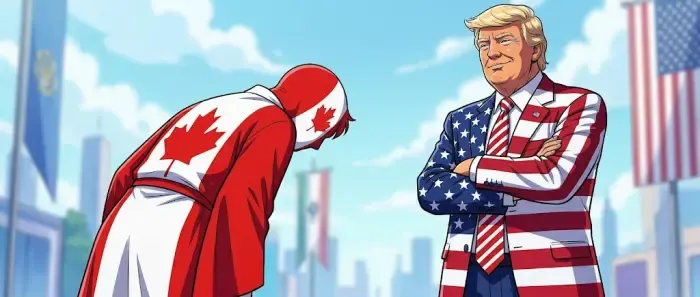
This one I’ll give some credit for creative writing.
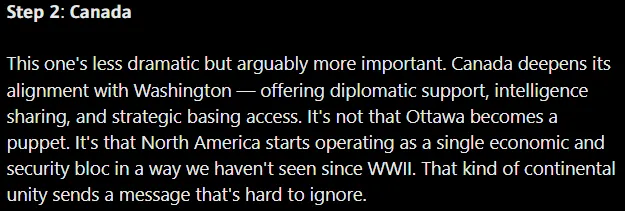
Canada was supposed to deepen its alignment with Washington – intelligence sharing, diplomatic support, becoming a single continental security bloc. The theory was written as though Pierre Poilievre won the election and handed Trump the keys to the continent.
Mark Carney won actually. He won by explicitly running against Trump. His victory speech described the old US-Canada relationship as “over”. Something even Trump could understand I guess. So let me get this straight? The man who sold himself to voters as the best person to “stand up to Donald Trump” is now going to deliver North American unity on Washington’s terms?
Now in January, Canada signed a new trade deal with China – opening Canadian agriculture to Chinese markets, Canadian roads to Chinese EVs. Guess what? American officials were not pleased. Trump responded by doing what he does best: threatening Carney with 100% tariffs.
So the country that is supposed to be the diplomatic bridge enabling Russia’s reintegration (see later) into Western markets is instead… pivoting toward Beijing. While its prime minister calls the American relationship a “betrayal”. Yup, that’s going well…
Step 3: Striking Iran solves China’s energy problem

Alright. Let me think about the logic here for a second.
The theory says: China loses Venezuelan oil, so it pivots to Iran. Then the US and Israel strike Iranian nuclear sites, oil facilities, command infrastructure. China’s backup source disappears.
Two problems, one catastrophic.
First: China already gets roughly 90% of Iran’s oil exports. That’s not a backup – that’s a core artery. And unlike Venezuelan sludge, Iranian crude is among the easiest oil in the world to refine. Light, low sulfur, covering the full product range from LPG to fuel oil without exotic processing equipment. A refinery built for Iranian crude can run it through standard configurations and walk away with gasoline, diesel, jet fuel, the lot. The substitution the theory assumes would be painful is actually a lateral move to a better feedstock. China isn’t downgrading. China is upgrading.
Both sides have built the financial and logistical plumbing to keep that trade flowing regardless of what Washington wants. If you wanted to actually cut it off, you’d need secondary sanctions enforcement aggressive enough to threaten Chinese banks and refiners with total exclusion from the dollar system. That’s a different war entirely.
So what did Iran do? Don’t look so shocked!? It announced that ships from China, Russia, India, Iraq and Pakistan are allowed to transit the Strait. Western vessels are not. Iran turned the Strait into a geopolitical sorting mechanism – and China is on the right side of the velvet rope. The plan to isolate Beijing from Iranian oil managed to produce the exact opposite.
Second: if (when?) Iranian oil facilities would be struck, this would cause an immediate oil price spike by fear of reprisals. We don’t even have to speculate about this one anymore. Israel struck the LNG field of Iran, Iran struck the one of Qatar. Eye-for-an-eye as I called it.
Who benefits directly and immediately from oil above $100? Russia. The same Russia the theory needs to be squeezed into capitulation in step four. Washington just handed Moscow the revenue cushion it needs to tell them to get lost – and it’s happening right now, in real time.
The sequencing doesn’t work. It actively undermines itself.
Step 4: Russia pivots to the West… because of ?vibes?
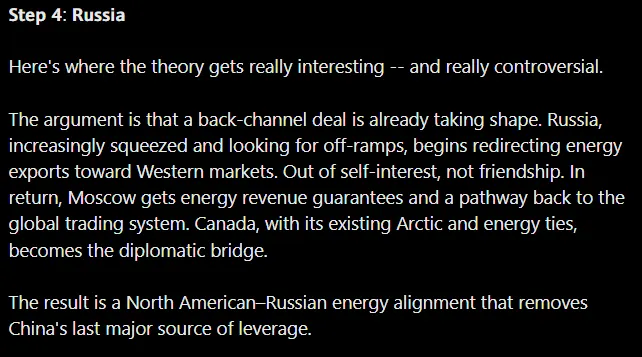
This is where the theory starts sounding less like geopolitics and more like fan fiction.
The argument is that Russia, “increasingly squeezed”, decides to redirect energy exports toward Western markets and accepts a “back-channel deal” with Washington. Canada plays the diplomatic bridge. A North American-Russian energy alignment emerges, removing China’s last leverage.
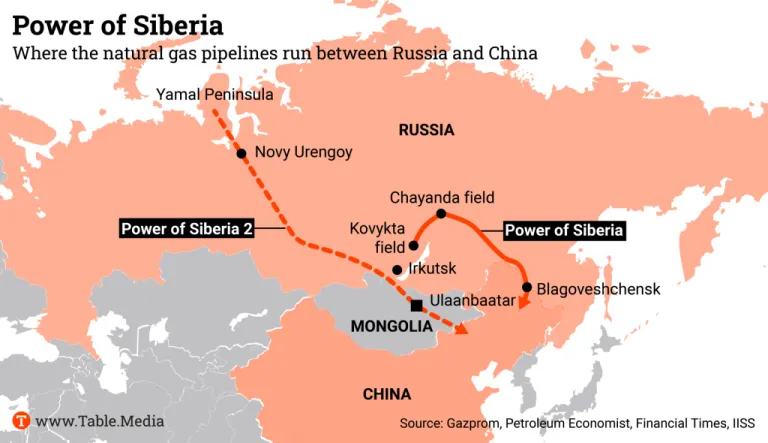
Back in the real world however, Russia’s trade with China hit record levels in 2024, and then again in 2025. The Power of Siberia 2 (gas through Mongolia to China) is still being developed. Russian oil goes east because that’s where the buyers are.
The idea is that Russia would pivot its entire energy export infrastructure back towards Western markets. Mind you! Markets that have been trying to sanction Russia out of existence since February ‘22. Small detail. Well, that would also require you to believe that Putin will voluntarily undo three years of economic hardship. All because of a back-channel promise from the country that froze Russian assets? Details… details…
You got to give more credit to Russians than that. They watch geopolitics through the lens of “what countries actually do”, not “what do they say”. They watched the US freeze their assets. They watched Iraq, they watched Libya, they watched Afghanistan. They watched the US tear up agreements, change terms mid-deal, and invoke force majeure whenever convenient. Trump himself demonstrated this tendency more vividly than anyone, slapping tariffs on nominal allies without warning and reversing positions on a Thursday afternoon. If you’re Moscow and Washington offers you a “pathway back to the global trading system” – you know exactly what that pathway is worth the moment you stop being useful.
But this ‘law of the jungle’ cuts both ways. If Trump showed everyone that agreements mean nothing and power is the only currency, why would Russia even believe any deal they cut with him would outlast the next election, or his next mood swing?
And what’s in it for Putin? His political legitimacy rests on the anti-Western narrative. Cutting a deal with Washington that looks like capitulation would be domestically catastrophic. The proposed theory needs Russia to behave like a rational actor optimising for economic returns. Putin – in my opinion – is a rational actor optimising for survival, which is a very different function.
The endgame: BRICS collapses, Beijing surrenders
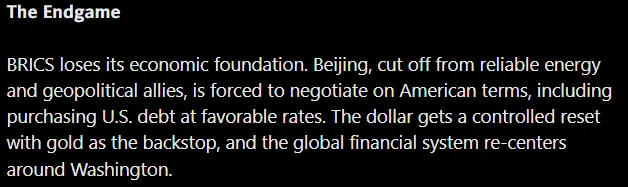
Once you’ve stripped China of its Venezuelan oil (4% of imports), its Iranian oil (actually fine), and its Russian alignment (not happening), BRICS supposedly loses its economic foundation and Beijing comes to the table to buy US debt at favourable rates.

Let me just note what BRICS actually is. B-Brazil. R-Russia. I-India. C-China, S-Spain. (nah just kidding) S-South Africa. All members. None of these countries lose anything if Venezuela’s Maduro goes to a US cell. India has been deepening its own Russian energy relationship. Brazil is not a Chinese energy client. The “economic foundation” of BRICS does not run through Venezuelan heavy crude.
China also has already like $3 trillion in foreign exchange reserves. They’ve been reducing US Treasury holdings for years. Deliberately. The idea that cutting a handful of discounted oil flows forces Beijing into “purchasing US debt at favourable rates” misjudges both the leverage and the desperation levels on each side.
The Bitcoin + Stablecoin layer

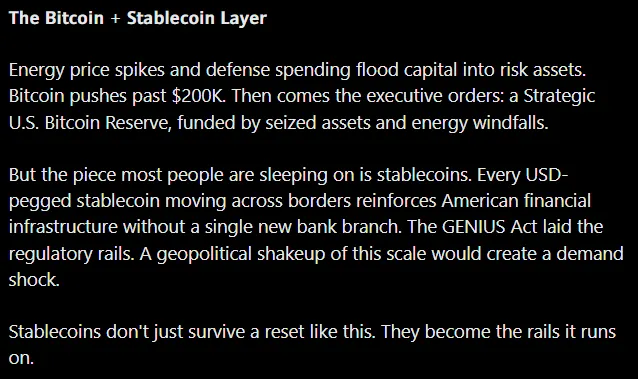
Waddayaknow? The Strategic Bitcoin Reserve does already exist! Trump signed it by executive order. And the effect on dollar hegemony, global financial architecture, or China’s strategic calculations was… nothing. Bitcoin went up a bit, went down a bit, and the world kept turning. The actual reserve is built from seized criminal assets – a one-time, non-renewable source. There’s no mechanism to keep topping it up from “energy windfalls” unless you think the US is going to start selling Venezuelan oil for Bitcoin, which is a sentence I wouldn’t even think to write in jest.
The Bitcoin ETF angle (iBIT and friends) is the same story. Yes, institutional Bitcoin products now exist. They make it easier for pension funds to get exposure. They also make it easier for institutional players to short it, hedge it, and control the price action – which is arguably the opposite of what Bitcoin maximalists wanted. The ETF didn’t create stablecoin dollar dominance. It created another tradeable risk asset that moves with the Nasdaq.
The logical chain from “oil spike” to “Bitcoin $200K” to “stablecoin rails underpin the new dollar system” is doing about five unearned jumps in a row.
The stablecoin point is arguably the most interesting, and also the most oversold. There’s a real argument that USD-denominated stablecoins extend dollar reach through informal channels. But that has nothing to do with whether the Venezuela-Iran-Russia energy isolation play succeeds. Stablecoin adoption runs on network effects and trust, not military operations in the Caribbean.
The actual problem
Setting aside each individual step, the theory has a fundamental architectural flaw: it assumes sequential execution without adversarial adaptation.
Real geopolitics doesn’t work in numbered steps. By the time you’ve executed step one, your adversaries have already adapted to step two, three, and four. China has been preparing for financial and energy decoupling from the West for a decade. Belt and Road. Domestic semiconductor investment. Yuan internationalisation. Shadow tanker fleets. Domestic solar and nuclear buildout at staggering scale. These aren’t improvised responses. They’re a decade of deliberate preparation for exactly this scenario.
The theory also assumes the US can run simultaneous pressure campaigns against Venezuela, Iran, AND Russia, while managing a trade war with China, Canada, the EU, and apparently everyone else, and at the same time juggling an active hot war with Iran. All the while without the military, diplomatic, and economic machinery cracking under the strain. Let me let you in on a little secret: the US military is not sized to execute that many overlapping interventions. The US economy is not insulated from the oil price spikes this sequence creates. No matter what the oil ticker says. The US political system is not built for the kind of decade-long patience this plan requires.
And above all – it assumes Trump even has a plan.
A detailed, multi-year, sequenced geopolitical strategy with coherent endgame objectives. The man who announced Canadian tariffs via social media at 11pm, who publicly feuded with Canada’s prime minister while needing Canada as a “diplomatic bridge” in this very theory. The man whose administration has contradicted itself on Venezuela policy multiple times in the same week.
The moves are real. The chaos is real. Connecting them into a master plan is seductive precisely because it offers the one thing the current moment doesn’t: the comfort that someone, somewhere, knows what they’re doing.
They don’t.

••••
The Liberty Beacon Project is now expanding at a near exponential rate, and for this we are grateful and excited! But we must also be practical. For 7 years we have not asked for any donations, and have built this project with our own funds as we grew. We are now experiencing ever increasing growing pains due to the large number of websites and projects we represent. So we have just installed donation buttons on our websites and ask that you consider this when you visit them. Nothing is too small. We thank you for all your support and your considerations … (TLB)
••••
Comment Policy: As a privately owned web site, we reserve the right to remove comments that contain spam, advertising, vulgarity, threats of violence, racism, or personal/abusive attacks on other users. This also applies to trolling, the use of more than one alias, or just intentional mischief. Enforcement of this policy is at the discretion of this websites administrators. Repeat offenders may be blocked or permanently banned without prior warning.
••••
Disclaimer: TLB websites contain copyrighted material the use of which has not always been specifically authorized by the copyright owner. We are making such material available to our readers under the provisions of “fair use” in an effort to advance a better understanding of political, health, economic and social issues. The material on this site is distributed without profit to those who have expressed a prior interest in receiving it for research and educational purposes. If you wish to use copyrighted material for purposes other than “fair use” you must request permission from the copyright owner.
••••
Disclaimer: The information and opinions shared are for informational purposes only including, but not limited to, text, graphics, images and other material are not intended as medical advice or instruction. Nothing mentioned is intended to be a substitute for professional medical advice, diagnosis or treatment.


Leave a Reply